
This is a hyper-local article that likely has nationwide relevance.
When you observe the trajectory of modern local government, it is easy to view institutional decay as a product of pure malice or sudden incompetence. The reality, however, is far more mundane and far more dangerous. Systems rarely collapse because of active villainy. They erode because human institutions, left unchecked, naturally turn inward. They begin to prioritize process over outcome, policy posture over basic execution, and compliance theater over concrete results.
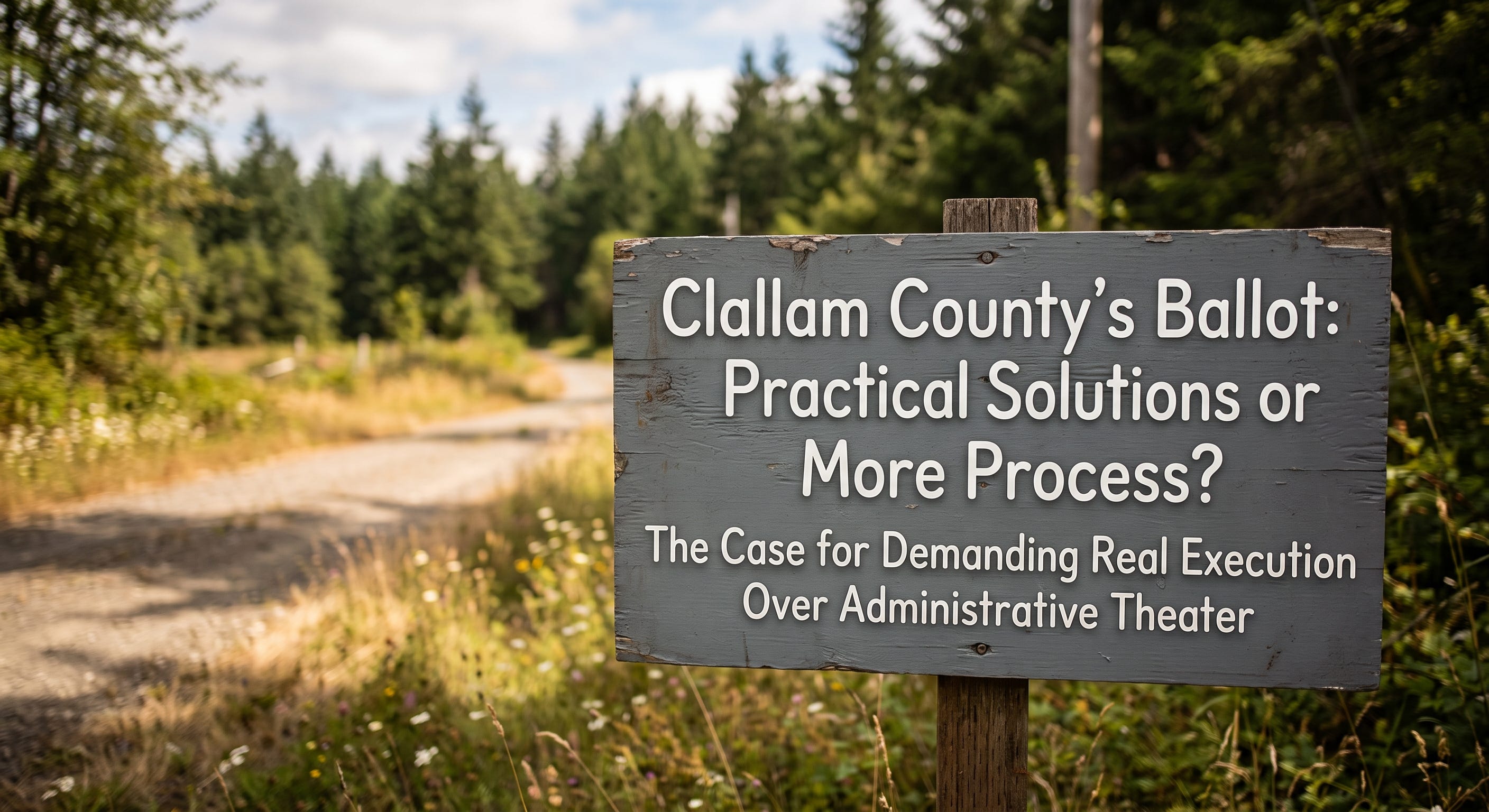
A good example: https://www.peninsuladailynews.com/2026/08/19/three-measures-heading-to-ballot/
Look closely at what is currently playing out on the Olympic Peninsula. As Clallam County voters prepare for the upcoming ballot, the Charter Review Commission has put forward three charter amendments. On the surface, these proposals are framed as triumphs of civic virtue. They mandate that county commissioners hold annual evening town hall meetings outside of normal working hours. They establish a new, independent ethics review board to police public official conduct. They require the county auditor to print the complete legal text of every proposed charter amendment in the local voters pamphlet.
It sounds responsible. It sounds like progress. But if you analyze these measures, a starkly different picture emerges. This is not reform. It is administrative distraction. It is the classic mechanism by which a bureaucracy attempts to manage the appearance of accountability without actually bearing the burden of competence.
Human beings are not blank slates that bureaucrats can redesign however they want. People operate under two very different views of the world. One view believes that human nature can be perfected if we just pass enough rules, build enough committees, and create enough government oversight to force people to be wise and honest.
The other view is grounded in real life and history. It accepts that human nature is fixed and flawed. When you give leaders power without immediate, real-world consequences, they naturally become lazy and protective of their own positions. Adding more layers of bureaucracy does not stop corruption or failure. It just gives irresponsible officials a brand new set of official rules to hide behind.
Consider the proposal to mandate evening town hall meetings in the county charter. Public engagement is undeniably a foundational good. But codifying a procedural requirement into a constitutional charter reveals a profound misunderstanding of incentive structures. Commissioners are already directly accountable to the voters every four years. They already possess the full legal authority to change their meeting times tomorrow.
Right now, standard commissioner business meetings take place during weekday mornings, a time when working families, business owners, and hourly employees are completely locked out of participation. If current leadership genuinely cared about public access, they would not need a ballot measure to fix it. They could simply shift their regular business meetings to weekday evenings right now. The Port Angeles Planning Commission already conducts its work in the evening, and it operates with perfect stability and consistency. Requiring a charter amendment to force a simple operational shift is classic can-kicking. It turns basic leadership initiative into a multi-year political debate while changing nothing on the ground today.
The proposal to establish an independent ethics review board is even more troubling. In theory, an ethics board sounds like a noble safeguard for public trust. In practice, as behavioral scientist Nassim Nicholas Taleb warns, non-accountable interventionist bodies almost never possess true skin in the game. When an oversight committee is created without direct exposure to the downstream consequences of its actions, it invariably becomes a mechanism for procedural harassment and ideological warfare.
State law already establishes legal standards, penalties, and disclosure requirements for public corruption. The Public Disclosure Commission exists to enforce transparency, and the power of recall remains in the hands of the electorate. Creating a permanent, taxpayer-funded county ethics board adds a secondary administrative apparatus that will consume legal fees, staff preparation hours, and executive sessions over dismissed or trivial grievances. When public faith in local government breaks down, you do not restore it by creating another layer of untrusted oversight. You restore it through direct, unvarnished exposure to performance metrics.
We must also confront the fundamental moral intuition that drives public frustration in Clallam County today. As social psychologist Jonathan Haidt demonstrated in his research on moral foundations, citizens possess deeply rooted intuitive senses of fairness, order, and proportional justice. When residents see open vagrancy, public drug addiction, rising property crime, and deteriorating local infrastructure, their core moral intuition signals that the social contract is actively breaking down.
When local leadership responds to these deep, functional crises not by enforcing order, repairing roads, or streamlining basic services, but by offering three new procedural updates to the county charter, the mismatch is offensive. The county has effectively become a dinner bell for public decay and open substance abuse, yet the administrative class is busy debating font sizes and text length in the voters pamphlet.
This is where the contrast between bureaucratic posture and real-world execution becomes undeniable. Consider how any private enterprise operates. In a real market economy, if an organization faces operational failure, deteriorating assets, and customer dissatisfaction, leadership does not spend six months designing a new internal review committee to debate whether managers should talk to customers. A private firm that tried such tactics would be bankrupt overnight.
Private companies survive because they are forced to operate with timely decision-making, direct accountability, and dynamic adaptation. When bureaucrats cite complexity as the reason why basic operational changes cannot be made immediately, they are not describing a technical reality. They are exposing the severe limitations of modern political leadership. They are revealing an inept culture that views administrative process as a shield and a substitute for real-world execution.
If the current Board of County Commissioners wants to earn genuine public trust and demonstrate real accountability, they do not need to wait for a November ballot. They could transform county operations tomorrow morning by implementing four common-sense, immediate actions.
First, immediately reschedule regular commissioner business meetings from weekday mornings to weekday evenings. Give working citizens, tradespeople, and local entrepreneurs the immediate ability to sit in the room, look their representatives in the eye, and speak on county business without sacrificing a day of pay.
Second, establish a live, public-facing digital performance dashboard. Instead of creating an ethics board to debate abstract complaints in executive sessions, expose county performance to raw public sunlight. Publish real-time data tracking how many days a building or land-use permit sits on a desk before approval, the exact line-item budget overruns on public works projects, public safety emergency response times, and precise county spending down to the vendor level. Raw metrics and immediate transparency expose lazy administration far more effectively than any panel of political appointees ever could.
Third, institute a mandatory performance audit across every county department before floating any new taxes, bond measures, or levy lifts. Require department heads to systematically identify and strip away redundant administrative steps in their permitting processes. Red tape actively stifles local economic growth, burdens small businesses, and prevents young families from building homes. Streamlining bureaucratic friction is a direct action leadership can take right now.
Fourth, mandate basic fiscal transparency by publishing a plain-language, single-page summary for every proposed contract, grant application, or budget adjustment at least two weeks before a vote occurs. The document should clearly state the total cost, the exact source of taxpayer funding, and the specific, measurable metric by which the project will be judged successful or unsuccessful.
These are not radical proposals. They are basic, pragmatic, common-sense measures that require zero charter amendments and zero added bureaucracy. The fact that they are not already standard practice tells you everything you need to know about the current state of local governance.
History demonstrates that human social arrangements are not locked into rigid biological destiny. As anthropologists David Graeber and David Wengrow pointed out in their historical analyses, early human societies were remarkably fluid, experimental, and conscious in how they constructed their civic structures. We are not trapped in a permanent fate of expanding bureaucracy and institutional decay. Modern administrative bloat is a choice, and it can be unchosen.
Ultimately, existential responsibility rests on the individual. The one thing that cannot be taken from a human being is the freedom to choose one’s attitude and take ownership of one’s actions. In the context of local civic life, taking ownership means refusing to accept administrative theater as a substitute for actual governance.
Real reform will not come from passing three new charter amendments that add more rules, more steps, and more process to an already bloated apparatus. It will come when the citizens of Clallam County reject the illusion of bureaucratic compliance, demand skin in the game from their elected officials, and insist that those in power execute their core duties with simple, transparent, and measurable competence.
For residents seeking to review the official ballot resolutions, verify their voter registration, or examine local election details ahead of November, comprehensive resources are available directly through the Clallam County Elections Division. You can also review local voting timelines and update your personal voter profile using the official Clallam County Register to Vote Portal.
My default voting stance is if it creates more government, I’m against it. And if there’s a way to accomplish something without relying on government to do it, I prefer it.
Like you point out about the ethics committee proposal, “the power of recall remains in the hands of the electorate.” If a group of dedicated citizens formed their own group, not regulated by government, and made it their group’s focus to work at recall efforts, I think that would be a good thing. Recalling is not an easy thing to accomplish, but neither is holding elected officials accountable through ethics committees, especially if all it results in is a monetary fine. The governor got fined this year, he’s still in office; so, that’s how ethics committees work in Washington State.
I agree with your views about if any elected official really wanted to make change, they could already do it. They don’t do it though; just look at Mr. French’s issue papers where he blames local government when he is local government and he has had the power all along to make changes and he hasn’t. Oh, wait, he organized a meeting, my bad. LOL.