
The Courage to Be Wrong
How My Friend Taught Me a Lesson in a Forgotten Facebook Thread
This post is a little different from my usual Substack articles. Rather than analyzing human behavior or evolutionary mechanics from a comfortable, academic distance, I’m putting my own blind spots under the microscope. We’re taking a trip back to a preserved-in-amber Facebook thread from three years ago to perform an honest autopsy on a debate I utterly lost—and to examine what it actually takes to catch yourself when your primitive brain takes the wheel.
We live in a hyper-reactive culture that treats changing your mind as a form of social treason. To admit that you were wrong—or even that your initial framing of an issue was reactive, incomplete, or hyper-defensive—is often viewed as a defeat.
But in both evolutionary biology and existential philosophy, the inability to adapt to new information is not strength; it is rigidity. In nature, rigid things break under pressure. Adaptation is the very engine of life.
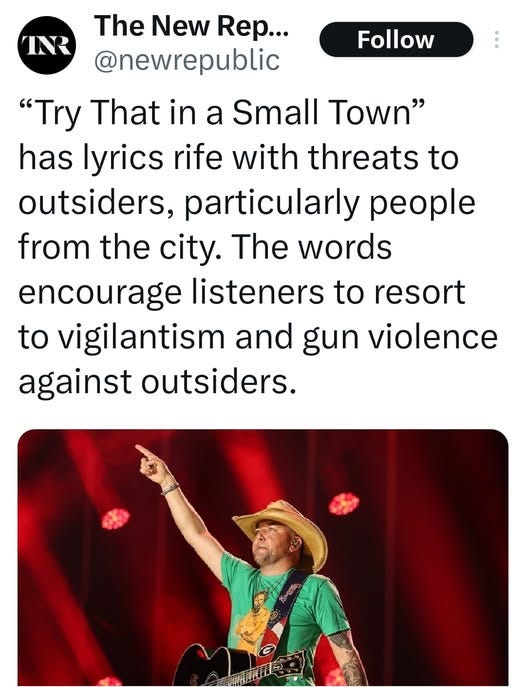
Three years ago, I started a digital brawl on my own feed about a viral, explosive country music track: Jason Aldean’s “Try That in a Small Town.”
My opening salvo was snarky, posture-heavy, and defensive:
“Listen, New Republic. You seem to be new around here. Here’s a tip. You’re just gonna LOVE 90’s West coast hip hop...”
You can still view the original Facebook thread here in all its unedited, preserved-in-amber 2023 glory.
Looking back at that artifact today, stripped of the immediate emotional atmosphere, the verdict is pretty plain: I got played, and I lost the argument.
I wasn’t engaging in profound philosophy; I was caught in the exact psychological architecture I usually try to criticize. My friend Erich was the clear intellectual victor of that exchange—not because he scored political points, but because his thinking was grounded, precise, and entirely detached from the tribal bait I was dangling.
Here is an autopsy of that thread, dissecting my own mental errors, the evolutionary traps of social media, and what it actually takes to exercise intellectual sovereignty.
The Trap of the Immediate Reactive Mind
To understand why I posted what I did, we have to look at our evolutionary machinery.
For 99% of human history, our ancestors lived in small, tight-knit bands where physical safety depended on two things: in-group cohesion and rapid identification of external threats. As Steven Pinker often notes, the human mind evolved within a “cognitive niche”—a set of behavioral and mental tools designed for survival, social status, and ancestral group alignment, not necessarily for objective truth-seeking in a hyper-connected digital global square.
When an outside force appears to challenge community norms, the ancestral brain doesn’t pause to run a double-blind study or conduct a nuanced socio-political analysis. It triggers an immediate, visceral response: Defend the boundary. Signal loyalty to the tribe.
When the song dropped, it pulled those exact evolutionary levers. And I took the bait hook, line, and sinker.
My mental error was false equivalence—a lazy attempt at whataboutism. By pointing at 1990s West Coast gangsta rap, I was attempting to neutralize criticism of one song by highlighting the violent themes of another. It was a cheap defensive maneuver designed to shield my team, but intellectually, it was completely hollow.
Erich stepped into the thread and dismantled my position with surgical precision:
“The thing is gangsta rap has way more to do with Woodie Guthrie style protest music or legit real country music than this piece of shit song... There really was/is gang and police related violence everyday in parts of Los Angeles. No one is trying to go into small town and take peoples fucking guns.”
Erich correctly identified that authentic regional music—whether outlaw country, dust-bowl folk, or 90s hip-hop—emerges organically from real lived experiences and structural pressures. What I was defending wasn’t authentic folk expression; it was top-down, corporate-engineered culture-war bait.
The Aesthetic Trap: Enjoying the Art vs. Defending the Argument
Here is where the self-exposure gets uncomfortable: I still like Jason Aldean, and I actually like the song.
Musically, “Try That in a Small Town” is a masterclass in driving, heavy-country production. It hits a visceral, primal chord. It taps into a grit, energy, and musical swagger that I genuinely enjoy when I’m driving down the road.
My second cognitive error—and one that millions of us fall into daily—was conflating aesthetic appeal with moral and logical truth. Because the song felt good to listen to, my primitive brain wanted to defend its lyrics and socio-political message as entirely valid.
It’s a embarrassing habit, but a human one: we like a beat, so we draft a legal defense for the lyricist.
That is an intellectual trap. You can appreciate the raw aesthetic power of a song, enjoy the artist’s work, and simultaneously step back to analyze its mechanics with cool detachment. Denying your genuine aesthetic preferences just to maintain “ideological purity” is a form of cowardice—but defending bad logic just because you like the riff is just plain stupid.
The Anatomy of the Thread: Best Arguments vs. Tribal Traps
When you examine the comment section long after the emotional dust has settled, the dynamic becomes crystal clear:
The Tribal Baseline
Another commenter stepped in with the quintessential, low-resolution tribal argument:
“The lyrics only threaten the assholes that come to do damage and commit crimes those morons deserve to get their asses kicked in any town they come to.”
This argument speaks directly to the ancestral instinct for local vigilante defense. But it completely ignores the subtle, dangerous shift from legal self-defense to mob rule.
Erich’s Masterclass in Precision
Erich systematically broke down why that logic fails in a constitutional republic:
“So I’m sure we can agree that the first three lines are crimes right? Unacceptable under any condition... However, if one was just to curse at a cop, or mess with a flag that wasn’t someone else’s property, hey that’s protected by the first amendment... It’s ‘if you do certain illegal things that I find disrespectful, or legal things that I happen to find disrespectful or that piss me off you’re gonna get fucked up.’”
He went further, calling out the manufactured paranoia embedded in the track:
“Guns which are mysteriously going to get ‘come for’ someday, which is grade A horseshit... What worries me is the defense of something that is so clearly a bullshit shill propagandist for identity politic wedging.”
Erich was right. The song draws no line between actual violent crime and constitutionally protected dissent. It sells a hyper-provincial fantasy that any behavior rubbing the “good ol’ boys” the wrong way justifies extralegal violence.
While I was busy deflecting with jokes about 90s hip-hop, Erich was defending the foundational principles of a free society: the rule of law, individual rights, and the rejection of mob rule.
The Anatomy of My Own Blind Spots
It’s easy to analyze psychological biases in abstract textbooks, but it’s much harder to catch them operating in real-time inside your own head. Looking back, my mental failures broke down into three distinct mechanisms:
In-Group Defense Bias: I allowed my instinctual desire to defend rural/small-town culture to blind me to how the song weaponized that very culture for profit.
Reflexive Deflection: Instead of evaluating the song’s actual lyrics, I used an out-group comparison (90s hip-hop) to shift the burden of proof. It’s the online equivalent of a child saying, “But he did it first!”
Falling for the Commercial Grift: As Erich pointed out, the song wasn’t even written by the artist; it was penned by a committee of Nashville songwriters for a multi-millionaire. I was playing the useful idiot for a corporate marketing campaign designed to monetize cultural division.
The Strategic Necessity of the Opposing Perspective
In evolutionary biology, an organism that relies solely on internal feedback loops eventually falls victim to sensory deprivation and blind-spot bias. To survive in a shifting environment, you need external sensors—weather gauges calibrated differently from your own—to tell you which way the wind is actually blowing.
The same is true for the mind. Surrounding yourself exclusively with people who validate your initial reactions is a recipe for cognitive atrophy.
Erich happens to be one of the most progressive friends I have. On paper, our political frameworks and worldviews often diverge sharply. But in a hyper-polarized environment, that divergence isn’t a barrier—it’s an asset.
When you maintain deep, honest friendships with people who view the world through a completely different ideological lens, they serve as a critical reality check. They test the structural integrity of your arguments. If your logic is flabby, defensive, or built on cheap tribal slogans, a friend like Erich won’t let you coast on it.
Keeping friends who see the world differently isn’t just about tolerance or polite civility; it’s about intellectual self-preservation. Without an opposing weather gauge, you have no way of knowing when you’ve drifted off course into your own echo chamber.
The Existential Pivot: Reassessment as Agency
In the architecture of existential psychology, Viktor Frankl famously noted that while we cannot always choose our circumstances—or suppress our initial, evolutionary gut reactions—we retain the “last of the human freedoms”: to choose our attitude in any given set of circumstances.
Social media is engineered to strip away that freedom. It demands an immediate, visceral stimulus-response loop. It wants you to react before your prefrontal cortex has a chance to turn on.
Exercising true human agency requires re-establishing that space—stepping back until the emotional noise dies down so you can evaluate reality as it actually is, rather than how your political tribe wants you to see it.
Changing your mind isn’t a sign of moral superiority, nor is it a grand achievement worth beating your chest over. It’s simply the bare minimum requirement for being a functioning, rational adult. As Jordan Peterson often emphasizes, before you attempt to order the world or win macro-cultural arguments, you must first “clean your room”—which includes sweeping out your own cognitive biases, emotional reactivities, and lazy intellectual habits.
To navigate the modern chaos without losing your head, a few basic rules apply:
Distinguish Happiness from Meaning. Winning a quick jab on social media yields a temporary hit of dopamine—a cheap, fleeting victory. Constructing a coherent, honest, and adaptable mental model yields enduring meaning. Meaning requires patience, effort, and the uncomfortable admission that your first reaction was probably wrong.
Separate Art from Ideology. Enjoy the music you enjoy without shame, but never feel obligated to defend the political posture of a commercial product just because it sounds great coming out of your speakers.
Maintain Friends as Ideological Weather Gauges. I am fortunate to have friends like Erich—one of the most progressive people in my circle—who refuse to let me slide on lazy logic. Seek out people who view the world through a different lens, not to win debates, but to test the structural integrity of your own thinking.
Looking back at that three-year-old Facebook post isn’t a badge of honor, but it is a useful benchmark. It’s a reminder of how easily any of us can get dragged down into low-resolution tribal battles if we aren’t paying attention.
The goal isn’t to be right all the time. The goal is to catch yourself when you’re wrong, take the hit, learn from the people who saw clearer than you did, and move on.
The Path of the Adaptive Mind
At its core, this autopsy isn’t really about a three-year-old song or a forgotten thread on a digital wall. It is about the continuous, disciplined effort required to remain a sovereign individual in a world engineered to turn us into reactive, tribal automatons.
Evolution didn’t design our prefrontal cortexes to win arguments on social media. It built our instincts to keep us safe within our small bands, to detect threats quickly, and to signal loyalty to our tribe at almost any cost. When we step into the digital town square, those ancestral mechanisms misfire. We mistake aesthetic pleasure for moral truth, defensive deflection for rigorous logic, and commercial rage-bait for authentic community solidarity.
Acknowledging this evolutionary mismatch is not an excuse for bad thinking—it is the very prerequisite for overcoming it.
As Viktor Frankl reminded us from the deepest abysses of human experience, we cannot always prevent our immediate, visceral impulses from firing. But we retain that singular, sacred space between stimulus and response. In that space, we choose our attitude. We choose whether to double down out of fragile ego, or to step back, sweep out our own cognitive blind spots, and thank the people who had the clarity to call out our bullshit.
Real intellectual sovereignty doesn’t mean having all the answers or getting it right on the first try. It means keeping your mental models agile enough to survive contact with reality. It means having the courage to look at your past mistakes not with shame, but with the quiet satisfaction that comes from knowing you are slightly less blind today than you were yesterday.
We are all navigating this hyper-connected, evolutionarily weird world together—imperfect, reactive, and constantly susceptible to the grift of outrage. The goal isn’t perfection; it’s trajectory.
So let’s keep questioning our own assumptions, holding our logic to higher standards, and giving ourselves and each other the grace to adapt. Let’s keep learning and growing together.